
Plant protein certificates and origin documentation
Plant protein purchasing requires more than confirmation of the protein name and price. This practical article helps food producers review specifications, certificates of analysis, origin statements, traceability records, market-specific declarations and supplier documents before approving samples or commercial orders.
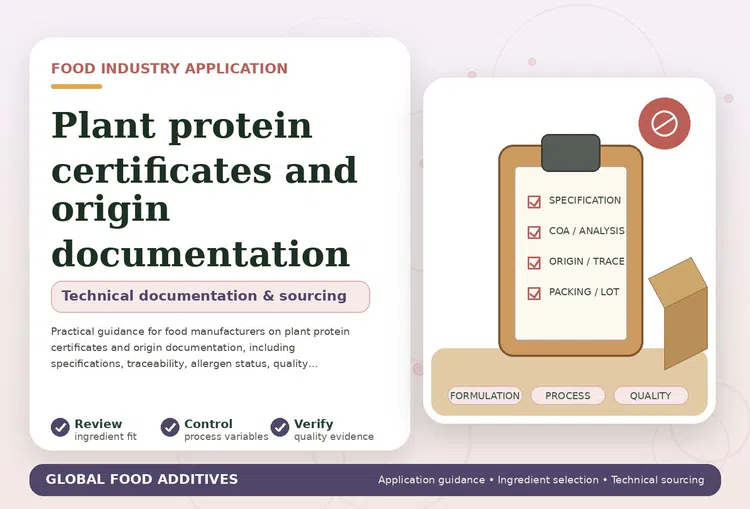
Application context
Plant protein documentation should be evaluated together with the exact commercial grade, intended food application and destination market. Relevant variables include the protein source, protein concentration, production process, ingredient composition, allergen status, GMO expectations, microbiological limits, packaging, shelf life, storage conditions and customer-specific approval requirements.
Products described as pea protein, soy protein, rice protein or another plant protein may be available as flours, concentrates, isolates, hydrolysates, textured products or standardized blends. These forms can differ in protein content, moisture, ash, flavour, colour, particle size and functional performance. Documents should therefore identify the precise grade being quoted rather than referring only to the general protein category.
Documentation also supports supplier qualification, incoming-goods inspection, label review, customs clearance and traceability. A technically suitable protein may still be unsuitable for purchase if required declarations are missing, expired, inconsistent or issued for a different manufacturing source.
Core certificates and technical records
The required document package depends on the ingredient, customer standard and destination market. Buyers commonly begin with the following records:
- Product specification: defines agreed physical, chemical, microbiological and functional limits for the commercial grade.
- Certificate of analysis: reports selected test results for the specific production lot or shipment batch.
- Technical data sheet: may include composition, typical values, processing guidance, application information and recommended storage.
- Safety data sheet: provides handling and safety information where applicable, although it does not replace a food specification.
- Allergen statement: identifies intentionally added allergens and relevant cross-contact risks at the manufacturing site.
- GMO declaration: states the supplier's status, testing approach or identity-preserved position where relevant.
- Shelf-life statement: confirms the expected storage period under specified packaging and environmental conditions.
- Packaging specification: describes bag material, net weight, pallet pattern, lot coding and protective liners.
The certificate of analysis should be reviewed against the approved specification. Product identity, lot number, manufacturing or testing date, reported parameters and release status should be clear and consistent with the shipment documents.
Origin and traceability information
Origin statements can refer to different stages in the supply chain. Buyers should clarify whether the declared country relates to the agricultural raw material, the protein extraction plant, the final blending or packing site, or the legal country of origin used for customs purposes.
- Crop origin: identifies where the peas, soybeans, rice, wheat or other source material was grown.
- Processing origin: identifies where extraction, concentration, drying, texturizing or hydrolysis took place.
- Final manufacturing site: identifies the facility responsible for the commercial grade and lot release.
- Packing origin: identifies where the product was repacked when this differs from the production site.
- Customs origin: may follow specific trade rules and should not automatically be assumed from the crop source.
Traceability records should allow the supplier to connect the shipped lot with approved raw materials, production records, test results and packaging. Where origin is important for customer claims, procurement policies or tariff treatment, the required wording and supporting evidence should be agreed before purchase.
Selection and supplier-approval points
- Confirm the exact grade: match the product name, code and revision across the specification, certificate and commercial quotation.
- Review protein methodology: confirm the reported protein basis and test method when comparing products from different suppliers.
- Check composition: identify carriers, standardizing materials, lecithin, processing aids or other components that may affect labelling.
- Assess allergen controls: review both the plant source and cross-contact controls at the manufacturing facility.
- Compare microbiological limits: verify that limits and test methods are suitable for the intended food category and process.
- Review change notification: ask how the supplier communicates changes in origin, formulation, process, specification or manufacturing site.
- Check document validity: confirm issue dates, expiry dates, signatures and certificate scope before relying on approvals.
- Request trial material: documentation review should be supported by technical testing where functionality, flavour or colour is critical.
Additional documents and quality checks
Depending on the protein source, finished product and customer requirements, the approval package may also include:
- Halal or Kosher certification;
- vegan or vegetarian suitability statements;
- organic certification where applicable;
- non-GMO or identity-preserved documentation;
- pesticide-residue and contaminant statements;
- heavy-metal and mycotoxin limits;
- amino-acid profile and nutritional information;
- gluten status and cross-contact declarations;
- irradiation, ethylene oxide or fumigation statements;
- manufacturing flow and process description;
- food-safety and quality-system certificates;
- traceability, recall and change-control procedures.
Documents should be reviewed for internal consistency. For example, the product name, legal manufacturer, country of origin, shelf life and storage conditions should not conflict across the specification, certificate of analysis, label and commercial invoice.
Buyers may also maintain an approved-supplier checklist covering audit status, complaint handling, sample retention, testing frequency, subcontracting, notification periods and document renewal. These controls help reduce the risk of receiving a technically different grade under a familiar product name.
Related quality and procurement areas
This topic is commonly connected to Quality & Procurement. Plant protein documentation projects may involve several technical and commercial areas:
- protein specifications and certificate-of-analysis review;
- country-of-origin and traceability declarations;
- allergen, GMO and identity-preserved status;
- food-safety and manufacturing-site certifications;
- nutritional data and amino-acid profiles;
- packaging, storage and transport conditions;
- supplier approval, change control and document renewal.
How to turn this topic into an inquiry
Send the article title, plant protein source, product form, target protein content, intended application, quantity, destination country, required origin wording, mandatory certificates, packaging preference and shipment timing.
If you are comparing an alternative supplier, include the current specification, certificate of analysis, ingredient declaration and any customer-specific document checklist. Clearly identify which requirements are mandatory and which are preferred so suppliers can confirm availability before samples or quotations are prepared.